
Monday, 22 July 2013
Arum names as see by the web #9: Arus
I'm learning some unexpected things through exploring the web through the names of Arum. Such as this result, of Seb-i Arus.


Wednesday, 17 July 2013
400 CE. The Anonymous Herbal Written by a Roman African and Copied by Hand for Over 1000 years.
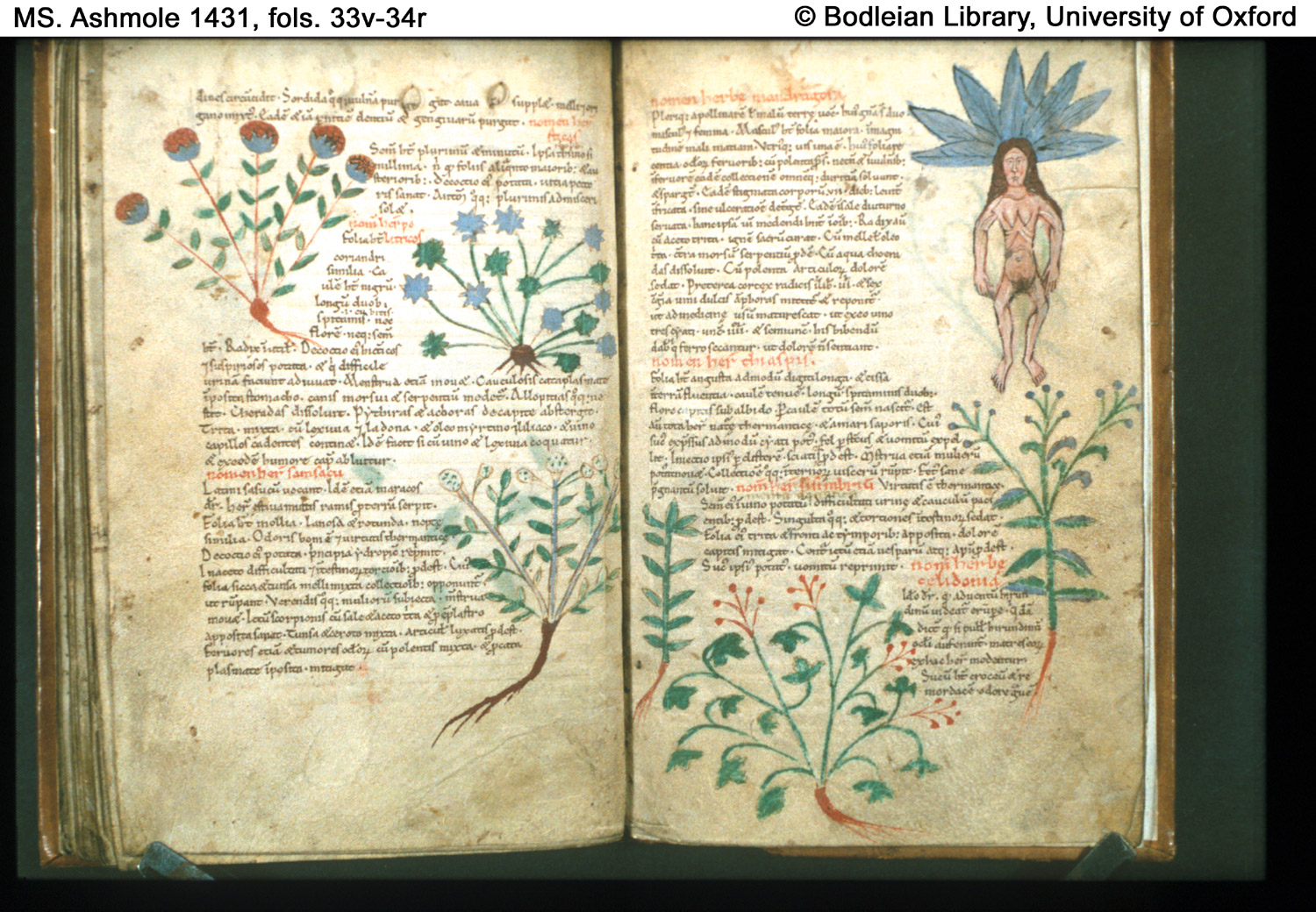
The Singularity of the Printing Press.
Prior to the invention of the printing press, herbal manuscripts were reproduced by being copied, written, drawn and bound by an individual's hand. There were rare, expensive and valuable items; each one at least a little bit, unique.
The printing press changed all of this. It was a new industry, creating a new world and ushering in new possibilities. In every field of endeavour the relative ease of printing meant that existing manuscripts along with bright-new works could suddenly be mass produced, expanding the accessibility to knowledge to more and more people. The new masters of the art: the printmakers, were quick to realise its potential.
The Incunabula Books.
The first herbals produced with this new technology were often simply printed reproductions of works which had already been in existence in manuscript form for hundreds of years. They are known collectively as the ‘Incunabula Herbals’, incunabula meaning ‘wrapped in swaddling clothes’, and so rather lovingly referring to works produced in the first 50 years of the printing press: the newborn books.
The Herbarium of Apuleius Platonicus.
One of the first herbals of these 'new born' books to be given the 'mass-production' treatment was a small volume known as the Herbarium of Apuleius Platonicus.
This was effectively a popular 'everyman's' version of Dioscorides' master tome. The original author is unknown, the name 'Apuleius Platonicus' being only a pseudonym, though some evidence points to the author being a writer from (what is now) Algeria, in Roman Africa called Lucius Apuleius. The herbal does also contain a number of herbs found in Northern Africa, but no one really knows for sure.
Copied by Hand for over 1000 years.
The content of the early hand written manuscript was drawn (ie copied) primarily from Dioscorides and Pliny and so popular was this herbal that, if it did indeed first appear in the 5th century, and was first printed in the 15th century, then it would have been in continual production, through being copied by hand, for over 1000 years by the time it was first printed.
It was one of the first, if not the first, translations of the Mediterranean herbal tradition into English and was around at the time of the Leechbook we have already looked at. When printed in the 15th century, it also became one of the first illustrated printed herbals, though the illustrations, being copies of copies of copies, were more 'artistic' than 'botanical'.
A copy of an English translation exists today in the British Library. It of course mentions Arum, as Dracunculus, giving much the same information as Dioscorides.
Tuesday, 16 July 2013
Arum names as seen by the web #8: Aron
Amidst the innumerable faces and, inexplicably, bare chests, lies this gem, by the artist Aron Demetz. Hence the link.


Thursday, 11 July 2013
Faery Lore, Elf Shot and Arum

9 CE: Bald’s Anglo Saxon Leechbook
Of our Anglo-Saxon herbal knowledge and practices, only a fraction has survived to this day. Most of what was known was never written down and much of what was is long destroyed, either deliberately by the early Normans or by the simple passage of time. What remains gives us a teasingly small glimpse into the world of our Anglo Saxon ancestors. Into a world of great herbal knowledge intimately intertwined with ancient rituals, deep superstitions and a firm belief in the elven folk.The Anglo-Saxon Leechbook of Bald is a manual of medical practices from the time of Alfred the Great. It exists only as a single manuscript, now housed in the British Museum and is the earliest known written medical lore from England. It is called ‘Bald’s’ leechbook because Bald was the person who ordered it to be compiled, by a scribe named ‘Cild’.
It may well be that it was created as part of King Alfred’s drive to create a more educated and equal society in his Kingdom. It is the oldest medical text known from the British Isles.
Leeches and Medical Bills.
Contrary to today’s usage, the word ‘leech’ in the title does not refer to the bloodsucking variety, but is the modern rendition of the Old English word 'laece', the word for a healer. This in turn is derived from the root word 'laekjaz', meaning enchanter or ‘one who speaks magic words’ (Polington 2000). 'Laece' is also related to another Old English word, 'lac', which relates to the practice of sacrifice and the offering of a gift or wealth.Here we come upon a very ancient association between magic, healing and the making of sacrifices, either to the Gods or to the ‘leechmen’ in return for health. With the Old English word 'laece-feoh', or ‘leech fee’, it illustrates the long-standing power of healers and doctors to extract wealth from patients – an ability retained to this day.
Inside and Outside Diseases and the Pagan Charms to Cure Them.
The manuscript itself is split into three different books; the first two cover the treatment of external and internal problems, respectively, with both books arranging the remedies in a head-to-foot fashion. The third book is a collection of magical charms, rituals and folklore as medical remedies. These are a fascinating collection of our ancestor’s beliefs which stem from a north european bedrock and show little of the Mediterranean influence so prevalent in other herbals. The herbal charms, superstitions and rituals recorded do not date from the 9th century but instead are an echo of a much older, pre-Christian time, dating back to the days of Beowulf. They form a curious mixture of Christian beliefs and pagan practices which were both swirling around together in these tumultuous times.Many illnesses were held to be the result of elf-shot, so much so that the longest chapter in the third book is entirely devoted to such elf-caused maladies. These were not the tiny gossamer fairies of Victorian times, but dark and powerful beings of nature who, more often than not, were unfriendly towards mankind. It was a ‘time when grown men believed in elves and goblins as naturally as they believed in trees’. (Rhode 1922)
The Knowledge of Herbs.
One of the notable features of the book is that it makes references to earlier ‘leechmen’, naming some of them and the remedies which they taught. Such references indicate that the records we have in Bald’s Leechbook are based on an even older tradition of healing which seemed to have already organised itself into a kind of professional body with its own ‘authorities’: an insight into Anglo-Saxon society for which we have no other evidence. Even more remarkable is that the Leechbook is written in vernacular Anglo-Saxon, not Latin, demonstrating that there was already a section of society that was literate yet separate from the Roman–Latin tradition of mainland Europe. That their knowledge was extensive is evidenced by the fact that even the very limited Anglo-Saxon literature which has survived mentions around 500 different plants, a number exceeded only by Dioscorides. Even famous European herbals such as the Herbarium of Apuleius described only 185 different plants and this was one of the most popular herbals in Europe.Arum in the Leechbook.
The Leechbook is, amongst many other things, a rare example of a tradition of healing and herbal knowledge in Europe not derived from Greek/Arabic sources. The Regarding Arum, it says:‘If a strong potion lodge in a man, and will not come away, take the netlierward part of celandine, and leaves of libcorn or arod, boil in ale, add butter and salt, give to drink a cup full of it warm.’
Further Reading for Bald's Leechbook and Anglo Saxon herbal practices.
The Old English Charms and King Alfred's Court.
http://hompi.sogang.ac.kr/anthony/mesak/mes101/Nokes.htm
Stephen Pollington’s book; Leechcraft, Early English Charms, Plantlore and Healing. Published in 2000 by Ango-Saxon Books.
Cockayne’s Anglo-Saxon leechdoms, wort cunning and starcraft of early England, from 1864. Available at: http://archive.org/details/leechdomswortcun02cock
Wednesday, 10 July 2013
Arum as seen by the web #7: Angels & Devils
Adam and Eve. Angels and Devils. Are you picking up on a theme here? Part of Arum's nature is to stimulate our instinctive predilection to pick up on the symbolism of duality, of opposites and in particular, of opposites united. Arum excels at this. We have always believed in good and bad 'spirits', otherworldly beings who populate the cosmos around us. Since time began it seems that we have perceived ourselves as surrounded by powerful, if non-material, beings, some of whom are friendly to us and some of whom are out of trip us up if not actively do us harm. Any duality slots easily into this cosmic duality, especially sexuality and gender. This is going to be a recurring theme with Arum so switch off now if you are of a sensitive disposition. With Adam and Eve we touched upon it in a slightly delicate, christian fashion. Now we're edging a bit closer. Angels and Devils. Do an image search on the web and you will instantly pick up on the sexual nature of this phrase. Suits Arum just fine thank you very much.
Here, an image of iconography in the marketplace.

Here, an image of iconography in the marketplace.
Monday, 8 July 2013
Arum names as seen by the web #6: Adder's Tongue
Adder's Tongue, as you've probably never seen it before:

From a World of Warcraft site. Adders Tongue is a level 77 herb, found in the Sholazar Basin. However, to grow Adder's Tongue, one needs a farming skill of at least 400 but if you have what it takes Adder's Tongue can enable one to loot Crystalised life. I never knew that.
From a World of Warcraft site. Adders Tongue is a level 77 herb, found in the Sholazar Basin. However, to grow Adder's Tongue, one needs a farming skill of at least 400 but if you have what it takes Adder's Tongue can enable one to loot Crystalised life. I never knew that.
Friday, 5 July 2013
Arum names as seen by the web #5: Adder's Root.
A rather mixed bag here, amidst the many many images of computational diagrams though lie some real gems. For sheer unusualness my pick is this one. The link being Adder and... Halloween.

For the full context, see the blog page itself here
For the full context, see the blog page itself here
Subscribe to:
Posts (Atom)